


About Skills Projects Experience Education Contact
MSc Robotics — TU Delft

Panagiotis
Sarikas

About Me

Hi, I'm Panagiotis 👋

I'm an enthusiastic Robotics and Mechanical Engineer with 3+ years of experience across robotics, engineering design, and project execution.

My work and interests focus on autonomous systems, motion planning, navigation, robot dynamics and control, intelligent control systems, machine perception, machine learning, and engineering-driven robotics solutions.

Delft, Netherlands
Panagiotis Sarikas

Skills

Programming
Python C C++ MATLAB
Platforms & Tools
Linux Git GitHub GitLab Docker Arduino Raspberry Pi
Robotics & Control
ROS2 Nav2 MoveIt MPC MPPI Motion Planning Machine Perception Machine Learning
Simulation
Gazebo RViz PyBullet
Symbolic AI & Semantic Reasoning
PDDL PlanSys2 SQL OWL SPARQL Ontologies TypeDB
Perception & ML Libraries
OpenCV TensorFlow PyTorch Keras YOLOv4
Engineering
SolidWorks ANSYS Onshape Simulink LS-DYNA XFOIL

Robotics & AI Projects

Selected robotics and AI projects from my TU Delft and NTUA studies.

01

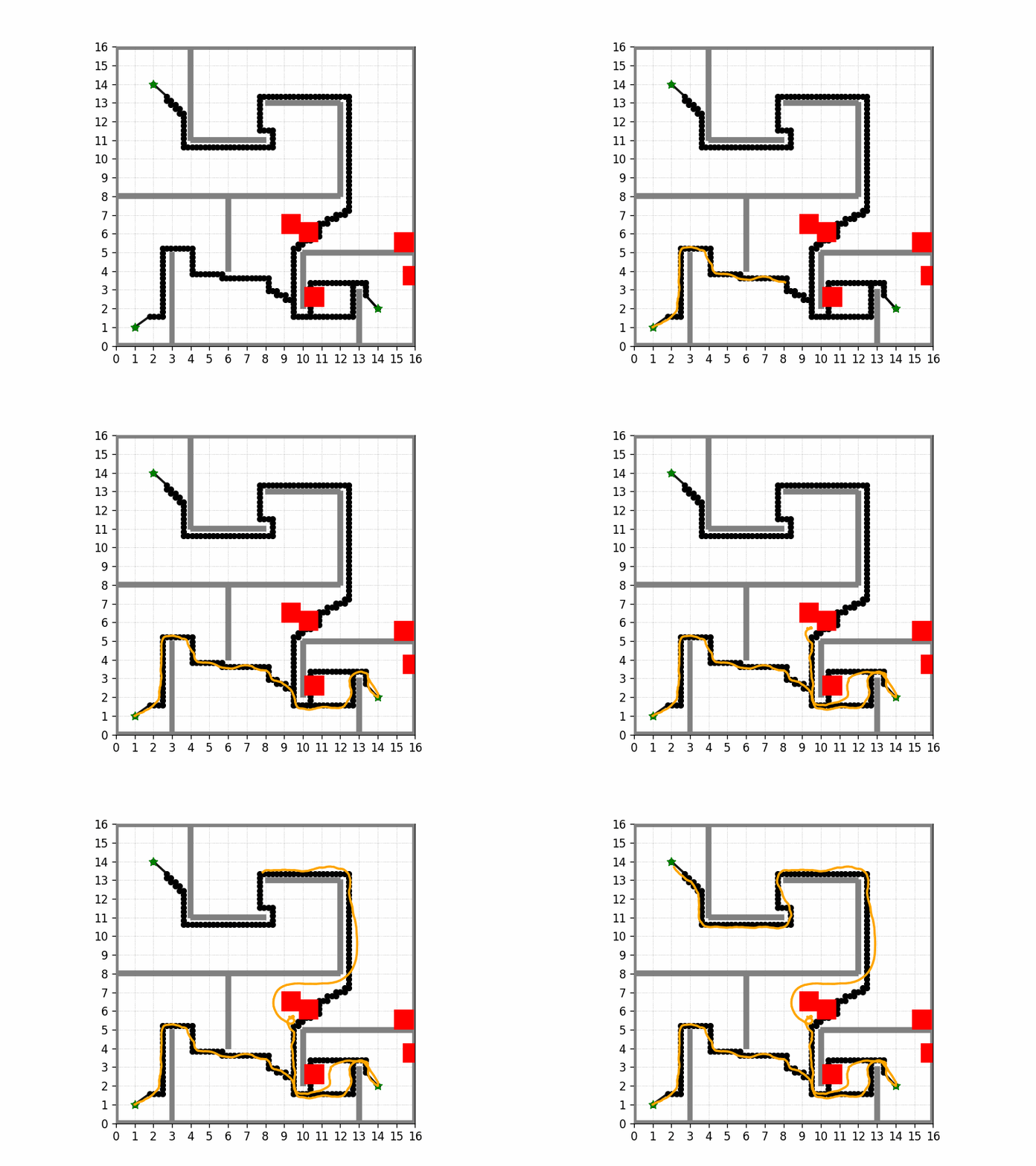
Hierarchical Quadrotor Planning & Decision-Making

Planning and Decision-Making · TU Delft
Quadrotor planning animated
Quadrotor indoor environment
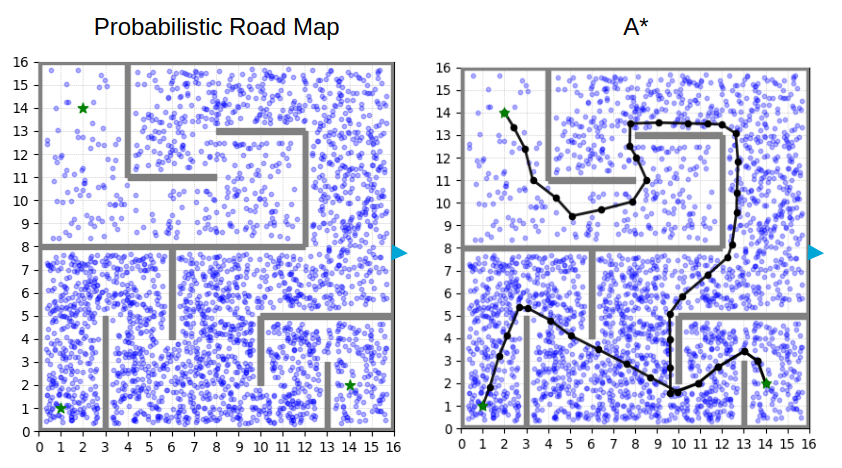
PRM roadmap and A* path
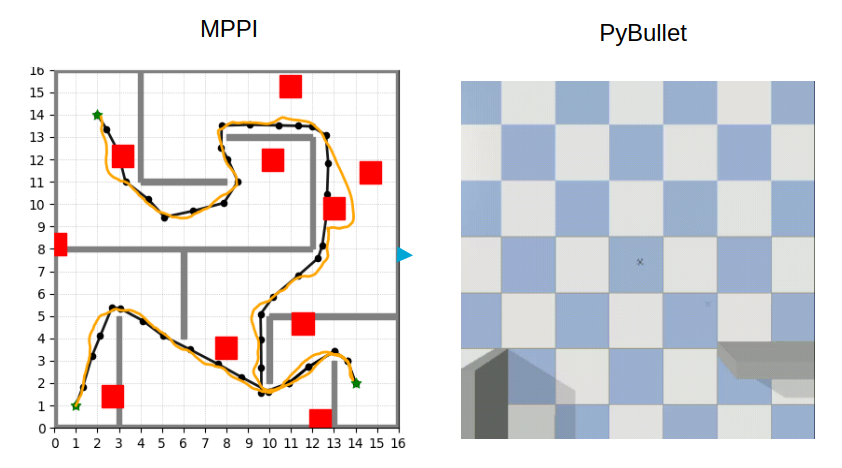
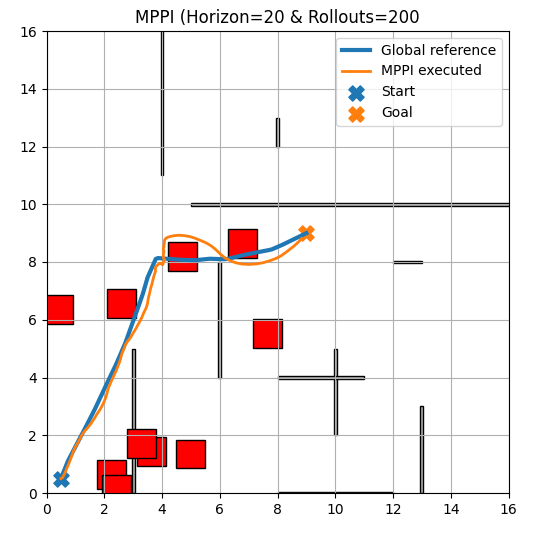
MPPI trajectory planning

Task: Navigate a quadrotor through increasingly complex indoor environments (open → cluttered → maze-like) visiting multiple goal checkpoints, while avoiding both known static obstacles and unknown dynamic ones that appear mid-flight.

Solution: A three-layer hierarchical architecture combining global path planning with local reactive control. A roadmap (PRM or Sukharev grid) is built once from the static map, and A*/Dijkstra computes shortest paths for each goal. An MPPI (Model Predictive Path Integral) controller follows this path in real-time, sampling thousands of candidate trajectories to track the reference while dodging unknown obstacles. A low-level PD attitude controller handles drone stabilisation. The system is evaluated in 2D and 3D simulation using gym-pybullet-drones.

Pipeline

  • Layer 1 — Global Planning (offline, once): Build roadmap from static map: PRM (random sampling) or Sukharev grid (uniform spacing). For each goal checkpoint: graph search (A* or Dijkstra) → output sequence of collision-free waypoints
  • Layer 2 — Local Planning (online, every timestep): Resample waypoints to uniform spacing → MPPI controller samples K random acceleration sequences, simulates each rollout over N steps, scores on tracking + velocity + effort + collision, weighted average → best acceleration, apply first command only (receding horizon) → deviates from path to dodge unknown obstacles
  • Layer 3 — Attitude Control (stabilisation): Acceleration → roll/pitch via differential flatness → PD controller stabilises orientation → drone executes motion in simulation

Design Choices, Challenges & Insights

  • PRM gives 20% shorter paths but grid is 6× faster and deterministic
  • Dijkstra unexpectedly beat A* in maze environments due to heuristic overhead
  • MPPI dodges unknown obstacles that PID blindly crashes into
  • Rollouts and horizon must scale together or performance degrades
  • Roadmap built once, reused for all goals — query time under 1 second
  • MPPI is derivative-free, handles non-convex obstacles naturally
  • Best config (K=2000, N=30) runs at only 1.2 Hz — needs GPU for real-time

02

Autonomous Robot Planning with Symbolic AI & Semantic Reasoning

Knowledge Representation & Symbolic Reasoning · TU Delft
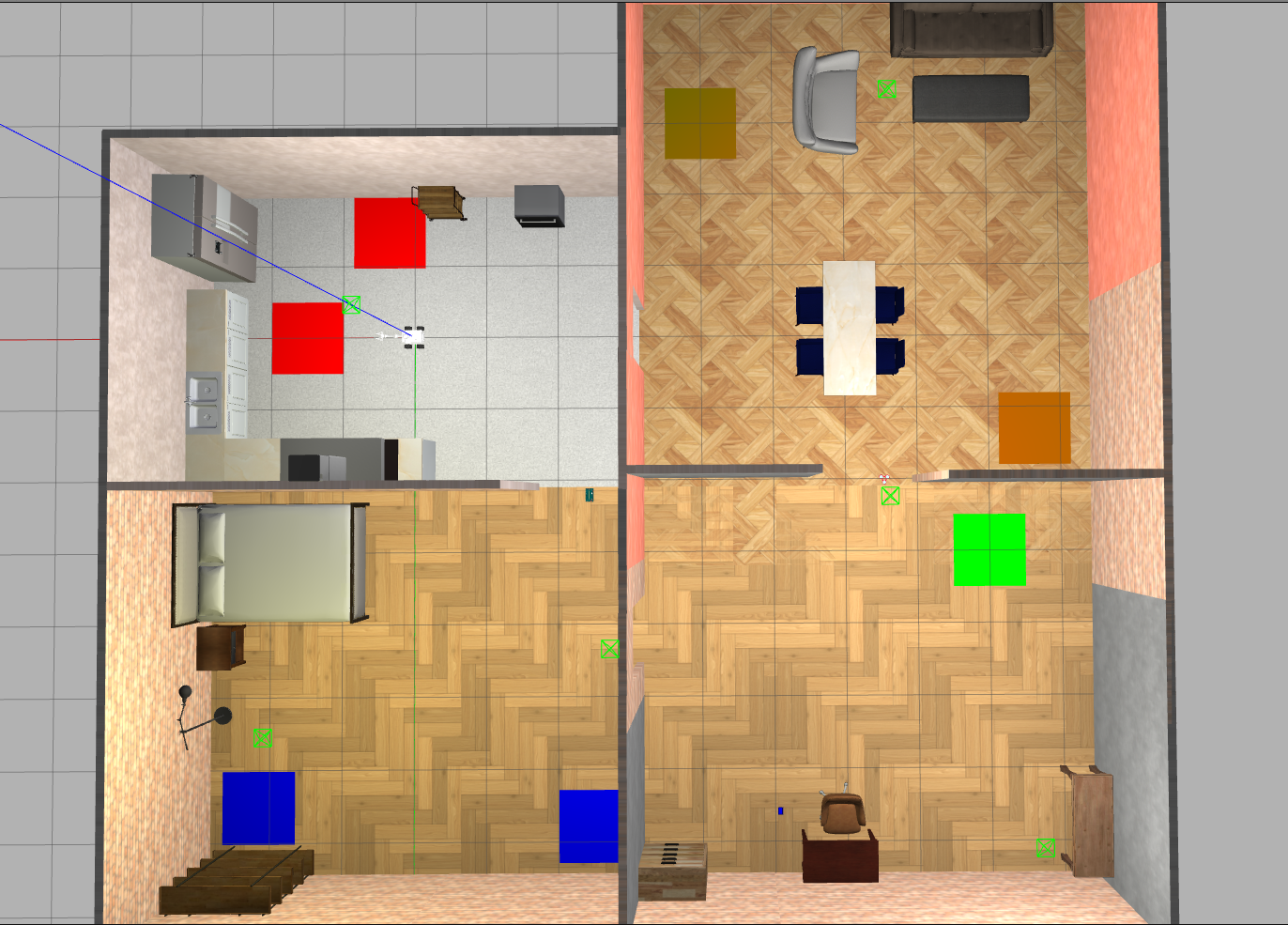
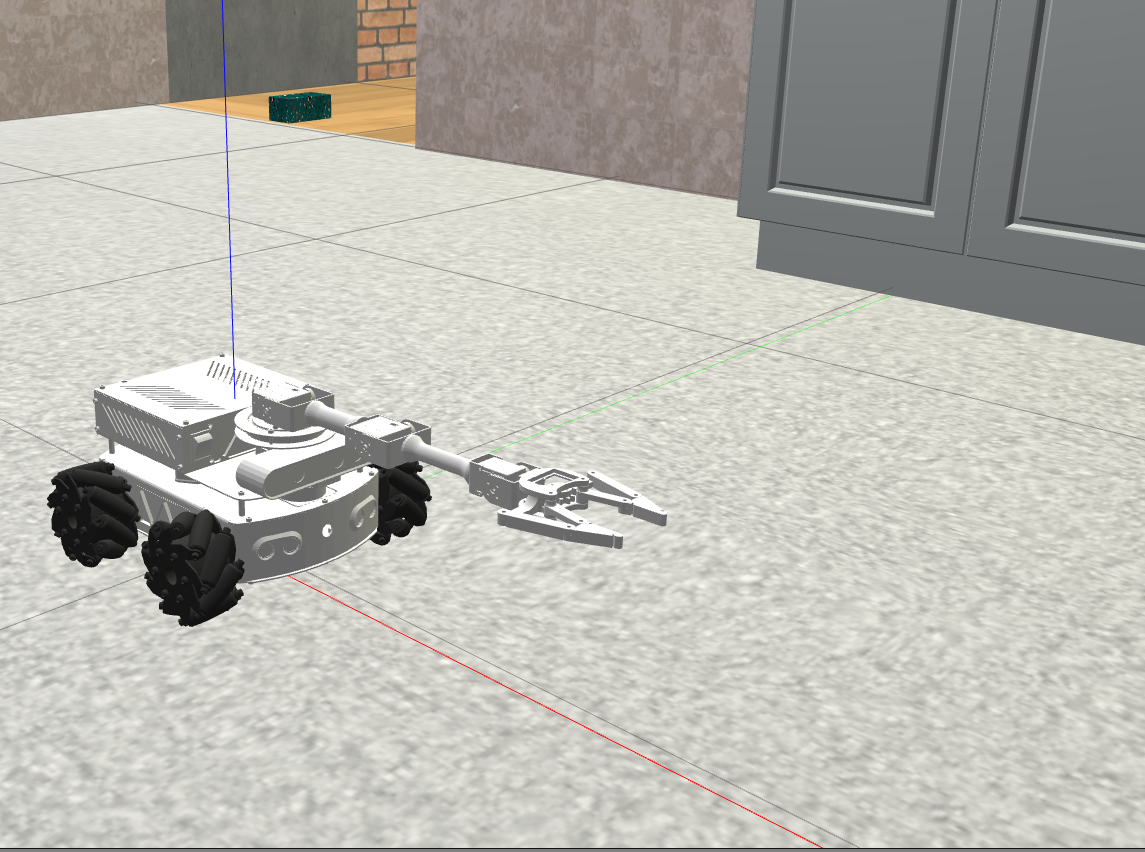
Mirte robot in Gazebo apartment Mirte robot close-up

Task: Develop a knowledge-based decision-making system for a mobile robot capable of autonomously tidying a simulated apartment, reasoning about object properties and locations, planning actions, and executing household tasks using symbolic planning and knowledge representation techniques.

The assignment included three tasks:
1. Simple Tidy Up: pick up all objects and place them in the closest drop location within the same room. 2. Tidy Up Following House Rules: place each object in the correct drop location based on semantic rules — tableware, toys, trash, or bedroom items. 3. Find and Bring an Object: locate and deliver a requested book using contextual clues and handling blocked doorways when needed.
Solution: Implements a hybrid autonomous robot architecture that combines symbolic planning (PDDL, PlanSys2) with a semantic knowledge base (TypeDB) for decision-making in dynamic, partially observable environments. The system enables adaptive task execution through real-time world modelling, semantic inference, and modular multi-stage planning. Evaluated on RoboCup-inspired tasks including object manipulation, semantic tidying, and contextual object retrieval in ROS2/Gazebo simulation.

Pipeline — Task 2: Semantic Tidy Up

  • Phase 1 — Discover: Robot enters each room, scans objects and drop locations, stores positions and IDs in TypeDB knowledge base
  • Phase 2 — Plan: Generate PDDL with abstract goals (“place obj_1 somewhere”, no destination specified yet) → planner solves action sequence: navigate → pick → move to drop → place
  • Phase 3 — Execute (per object): Navigate to object → pick it up → robot learns what the object is (e.g. “dirty cup”) → TypeDB updated → inference rule fires (“dirty tableware → dishwasher”) → query TypeDB for destination + coordinates → navigate → place

Pipeline — Task 3: Find and Bring the Book

  • Step 1 — Reason About Location: Query TypeDB for contextual clues: dirty tableware seen → book likely in Bedroom; clean tableware → Living Room; no clues → default Office. Reorder room exploration by likelihood
  • Step 2 — Navigate Between Rooms: Before crossing doorway, check if blocked. Blocked → pick obstacle, rotate 90°, drop to side, clear doorway. Clear → pass through directly
  • Step 3 — Explore Room: Inspect all objects (pick up to identify). Book found → deliver to semantic location. Not found → update clues, choose next room, repeat
  • Step 4 — Clean Up: Clear remaining blocked doorways, tidy all remaining objects using Task 2 semantic rules
  • Failure Recovery (throughout): Action fails → 360° recovery scan → update positions → replan. Brought success rate from 95% to 100%
03

Imitation Learning for Vision-Based Robot Control

Machine Learning for Robotics · TU Delft
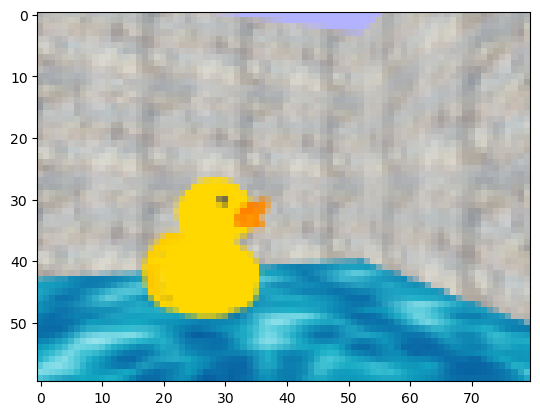
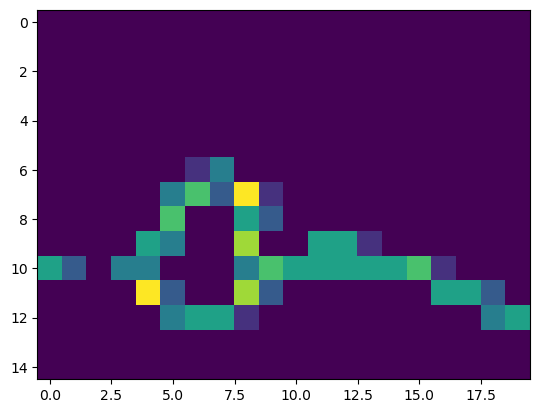
Imitation learning โ€” duck observation RGB Imitation learning โ€” feature map heatmap

Task: A mobile robot navigates simulated rooms collecting yellow “ducks.” A human operator manually controls the robot, generating demonstration data (RGB images + actions). The goal is to train a classifier that imitates the human’s behaviour — mapping raw visual observations to discrete navigation actions (move forward, turn right, turn left).

Solution: A robot learns a policy that maps RGB camera observations to discrete control actions by imitating human demonstrations. The task is formulated as a supervised multi-class classification problem, where each observation is classified into one of three actions: turn left, turn right, or move forward. A classifier (Random Forest, outperforming Decision Trees and CNN on this task) is trained on human demonstrations. The learned policies are evaluated both offline using classification metrics and online in a simulator to assess real-time control performance and generalisation to unseen environments.

Pipeline

  • Human teleoperation in simulation generates RGB frames (60×80×3) paired with discrete actions
  • RGB → HSV colour space; threshold Hue channel to isolate yellow pixels → binary mask
  • Max-pool with stride 4 → compact 15×20 feature map
  • Stack edge features (Canny edge detection + avg pool) for generalisation
  • Flattened feature vector fed to classifier: Decision Trees / Random Forest / CNN compared
  • Random Forest selected — best performance-to-complexity ratio
  • Predicted action (0, 1, or 2) executed by robot in simulator

Design Choices, Challenges & Insights

  • Colour-based segmentation was highly effective but environment-dependent
  • Feature engineering was crucial for reducing the learning problem complexity
  • Feature compression introduced a trade-off between efficiency and spatial detail
  • Edge features improved robustness beyond colour information alone
  • Imitation learning inherits limitations from the demonstrated behaviour
  • Adding a decision-making layer to prevent robot deadlock when no yellow duck is detected in the image
04

Multi-Sensor 3D Pedestrian Detection

Machine Perception · TU Delft
Pedestrian detection โ€” K3D point cloud Pedestrian detection โ€” LiDAR scan
Pedestrian detection โ€” bounding boxes Pedestrian detection โ€” detections

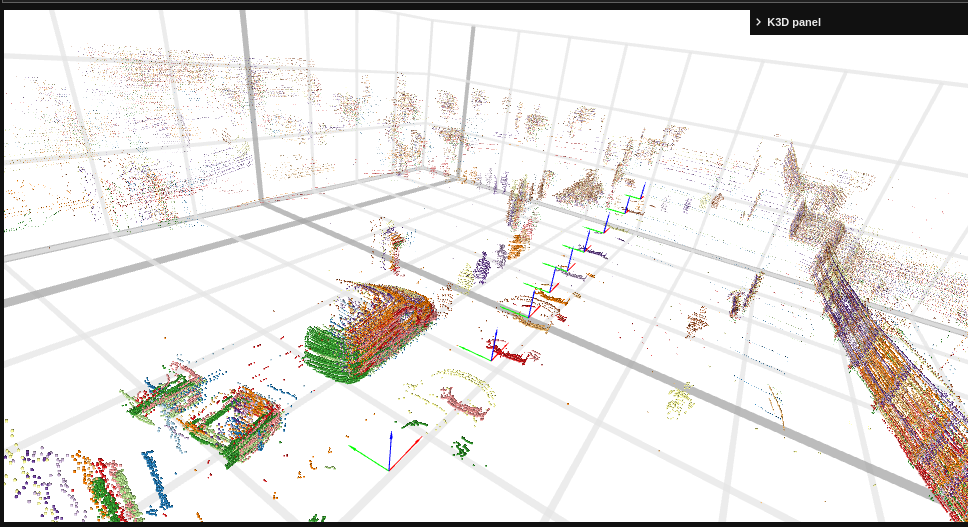
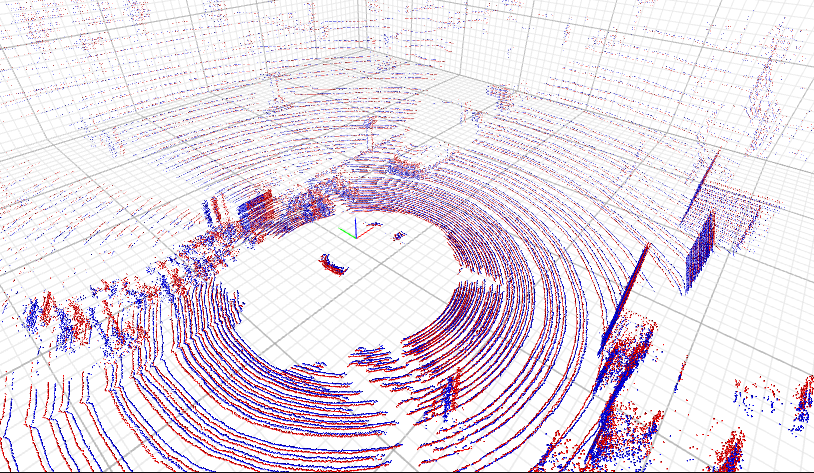
Task: Detect pedestrians in 3D space (camera reference frame) at distances of 5–40m, for pedestrian heights of 1.2–1.9m.

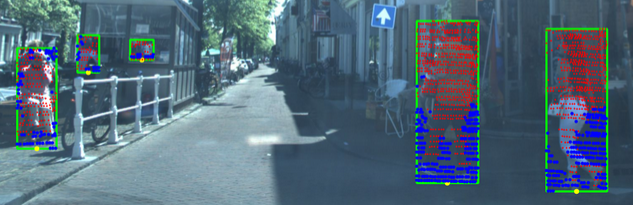
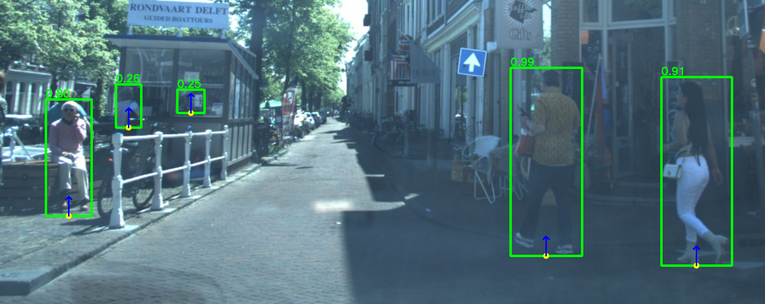
Solution: A detect-then-localize pipeline that combines YOLO-based 2D pedestrian detection with LiDAR and radar data to estimate accurate 3D pedestrian positions in the camera frame. The system applies geometric constraints, sensor fusion, and ground-plane backprojection to robustly localise pedestrians under varying distances and scene conditions.

Pipeline

  • Input: Camera image (1216×1936×3), LiDAR point cloud, Radar returns
  • 2D Detection: YOLOv4 forward pass (resized to 416×416) — filter class=“person” with confidence > 0.22, followed by NMS (threshold 0.35) to remove duplicate detections
  • Sensor Alignment: Transform LiDAR & Radar points into camera frame via extrinsic matrices; project LiDAR onto image plane via K × [x,y,z]ᵀ
  • 3D Localisation (per bbox): Compute foot-point (bottom-center pixel) and camera ray = K⁻¹ · [u,v,1]ᵀ. Select LiDAR points projecting inside bbox — if ≥6 points: use median depth of torso region (top 33% sorted by camera-y) to constrain the ray. Otherwise: intersect ray with ground-plane (aX+bY+cZ+d=0)
  • Geometric Constraints (soft scoring): Distance check (5–40m), height ratio check (expected 1.7m / dist vs pixel height), width check, radar validation (penalise if no radar return within 5m)
  • Output: 3D position (4×4 homogeneous transform), pedestrian dimensions, adjusted confidence score

Design Choices, Challenges & Insights

  • Detect-then-localize decouples the 2D detection problem from the 3D estimation problem
  • Torso-region depth (top 33%) is more stable than full-bbox median due to ground clutter near feet
  • Ground-plane fallback handles sparse LiDAR at long range where direct depth is unreliable
  • Soft geometric scoring avoids hard rejection — penalises unlikely detections while preserving recall
  • Radar contributes range validation rather than primary detection, complementing LiDAR sparsity at distance
  • Pretrained COCO YOLOv4 used directly — confidence threshold tuned empirically for pedestrian-only filtering
05

Autonomous Mobile Manipulator for Smarter Greenhouse Digital Twins

Multidisciplinary Project · TU Delft
Greenhouse Digital Twin โ€” RViz navigation
In Progress

Task: A mobile manipulator robot (Mirte) must autonomously navigate a greenhouse environment, detect and interact with plants, and maintain a live digital twin of the greenhouse state. The system must integrate perception, navigation, manipulation, and knowledge representation to support autonomous plant monitoring and data collection.

Solution: A multidisciplinary ROS 2 system combining autonomous navigation (Nav2), plant detection via computer vision, manipulation planning, and real-time knowledge graph updates. The digital twin is maintained through continuous sensor fusion and environment mapping, providing a queryable representation of the greenhouse state for higher-level task planning.

System Architecture

  • Navigation: Nav2 stack with SLAM-based mapping and localisation for autonomous traversal of greenhouse rows
  • Perception: Camera-based plant detection and status classification; point cloud processing for 3D plant localisation
  • Manipulation: Arm motion planning for reaching and interacting with plants at varying heights
  • Digital Twin: Real-time knowledge graph updated from sensor observations; queryable for task planning

Design Choices, Challenges & Insights

  • Modular ROS 2 architecture allows subsystems (navigation, perception, manipulation) to be developed and tested independently
  • Digital twin approach enables persistent environment representation beyond individual sensor readings
  • Multidisciplinary team collaboration required tight interface definitions between subsystems
  • Simulation-first development in Gazebo accelerated integration and reduced hardware risk
06

ROS2 Autonomous Mobile Robot Navigation

Robot Software Practicals · TU Delft
ROS2 navigation โ€” RViz costmap and Gazebo view

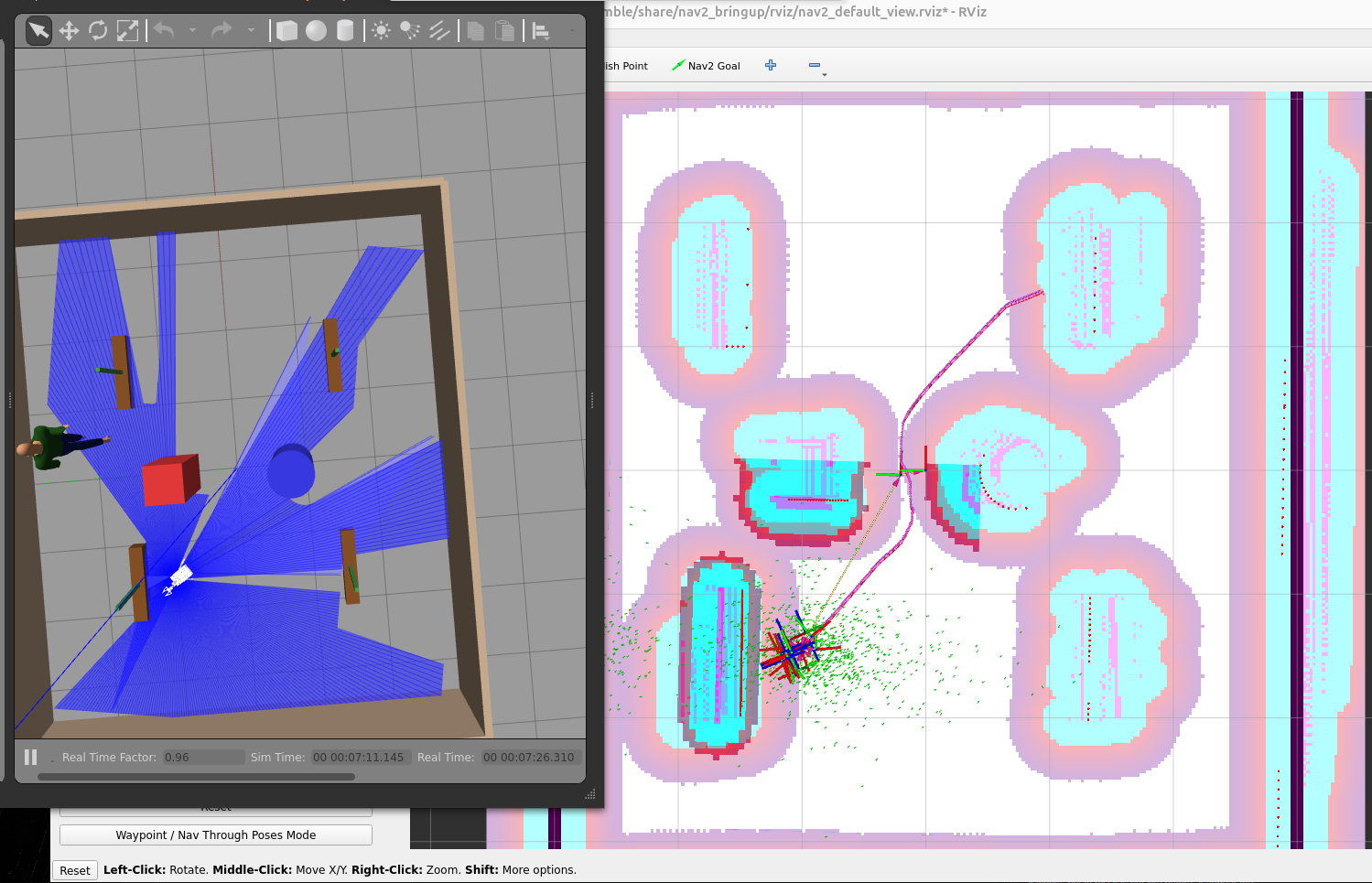
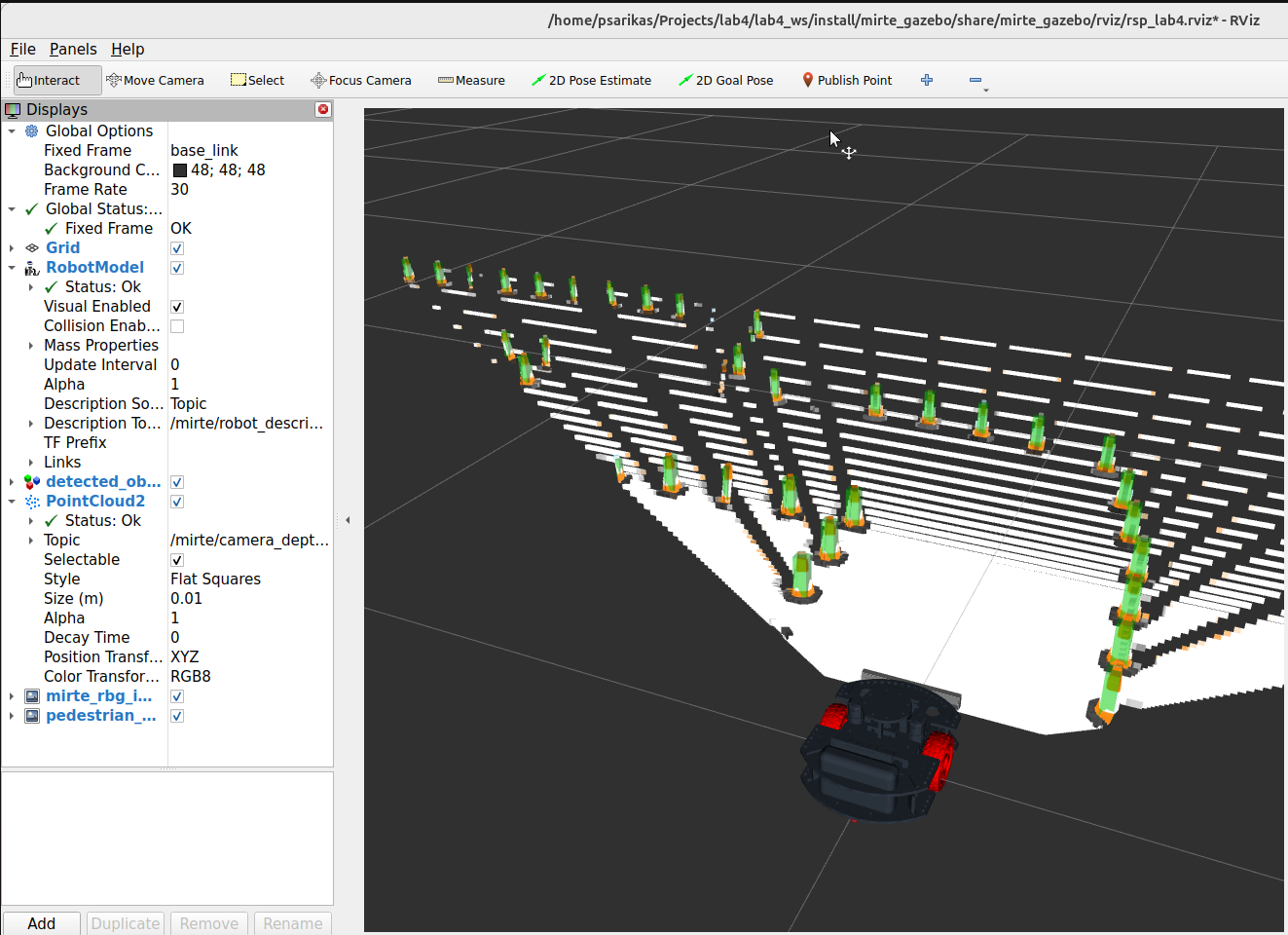
Task: A simulated mobile robot (Mirte) must autonomously navigate a cone-defined track, avoiding 3D obstacles detected from a depth camera point cloud and stopping permanently when a pedestrian is detected nearby in the RGB camera image.

Solution: A modular ROS 2 system with three nodes communicating via topics. A PCL-based obstacle detector processes depth camera point clouds to extract 3D bounding boxes of cones/barrels. An OpenCV-based pedestrian detector (pre-built) produces 2D bounding boxes of people. A control node fuses both detection streams, transforms obstacle positions from camera frame to robot frame using TF2, and publishes velocity commands to steer around obstacles and halt for pedestrians.

Pipeline

  • Depth camera publishes 3D point cloud → obstacle detector subscribes
  • Filter invalid/far points, remove ground plane via RANSAC segmentation
  • Euclidean cluster extraction identifies individual obstacles (cones/barrels)
  • Compute 3D bounding box per cluster, publish as Detection3DArray
  • RGB camera publishes image → pedestrian detector outputs 2D bounding boxes
  • Control node subscribes to both obstacle and pedestrian detections
  • Transform each obstacle from camera frame to robot base frame via TF2
  • Keep only obstacles in front (x > 0) and within 0.7m radius
  • Steer away from closest obstacle; stop permanently if pedestrian bbox > 2500 px²

Design Choices, Challenges & Insights

  • Ground plane removal essential — without it, floor points form false obstacle clusters
  • Small subscriber queue size (1) prevents processing stale point clouds and delayed reactions
  • Modular architecture: separate packages for detection and control, reusable independently
  • Pedestrian stop is permanent and irreversible — safety-first design choice
  • Obstacle detector runs at ~5 Hz, control node at ~10 Hz, both exceed the 1 Hz requirement
07

Model Predictive Control for Vehicle Lane-Keeping

Model Predictive Control · TU Delft
LQR vs MPC Regulator comparison โ€” state trajectories Terminal sets ICAS and QLS โ€” feasible region

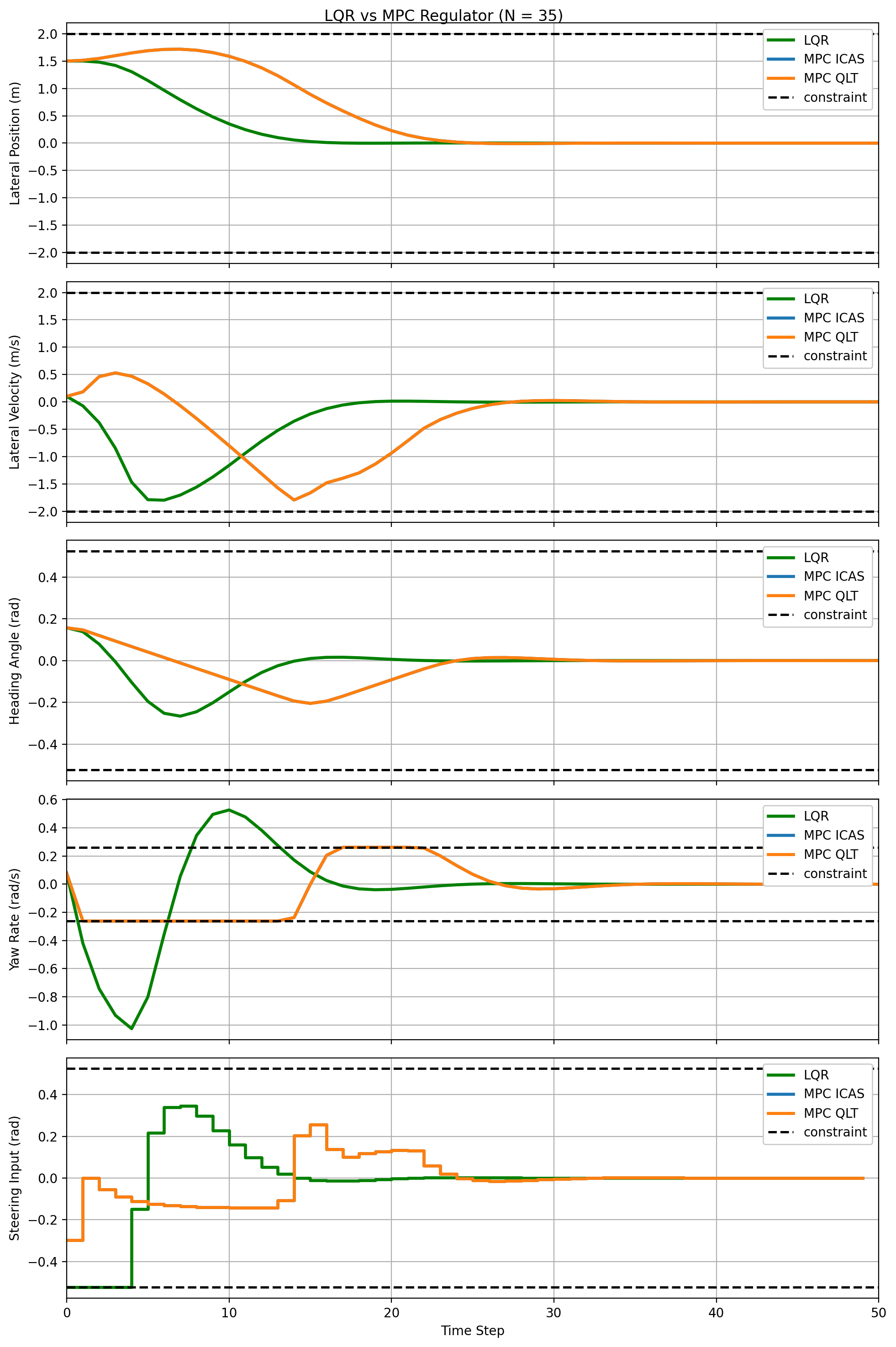
Task: Design a constrained controller for a vehicle lane-keeping assist system that regulates lateral position and heading errors while respecting steering limits, lane boundaries, and model validity constraints — something PID and LQR cannot guarantee.

Solution: A constrained MPC framework built on a linearized dynamic bicycle model. The vehicle state tracks lateral position error, lateral velocity error, heading error, and yaw rate error, with steering angle as the single control input. Terminal ingredients from the discrete algebraic Riccati equation (DARE) ensure closed-loop stability. Two formulations are developed: a regulation MPC for driving errors to zero, and an offset-free output-feedback MPC that uses a Luenberger observer to reject persistent road-curvature disturbances and measurement noise. Performance is benchmarked against LQR.

Pipeline

  • Linearized vehicle model discretized for digital control (4 states, 1 input)
  • Define constraints: lane boundaries, steering limits, model validity region
  • Regulation MPC: minimize tracking error + control effort over finite horizon
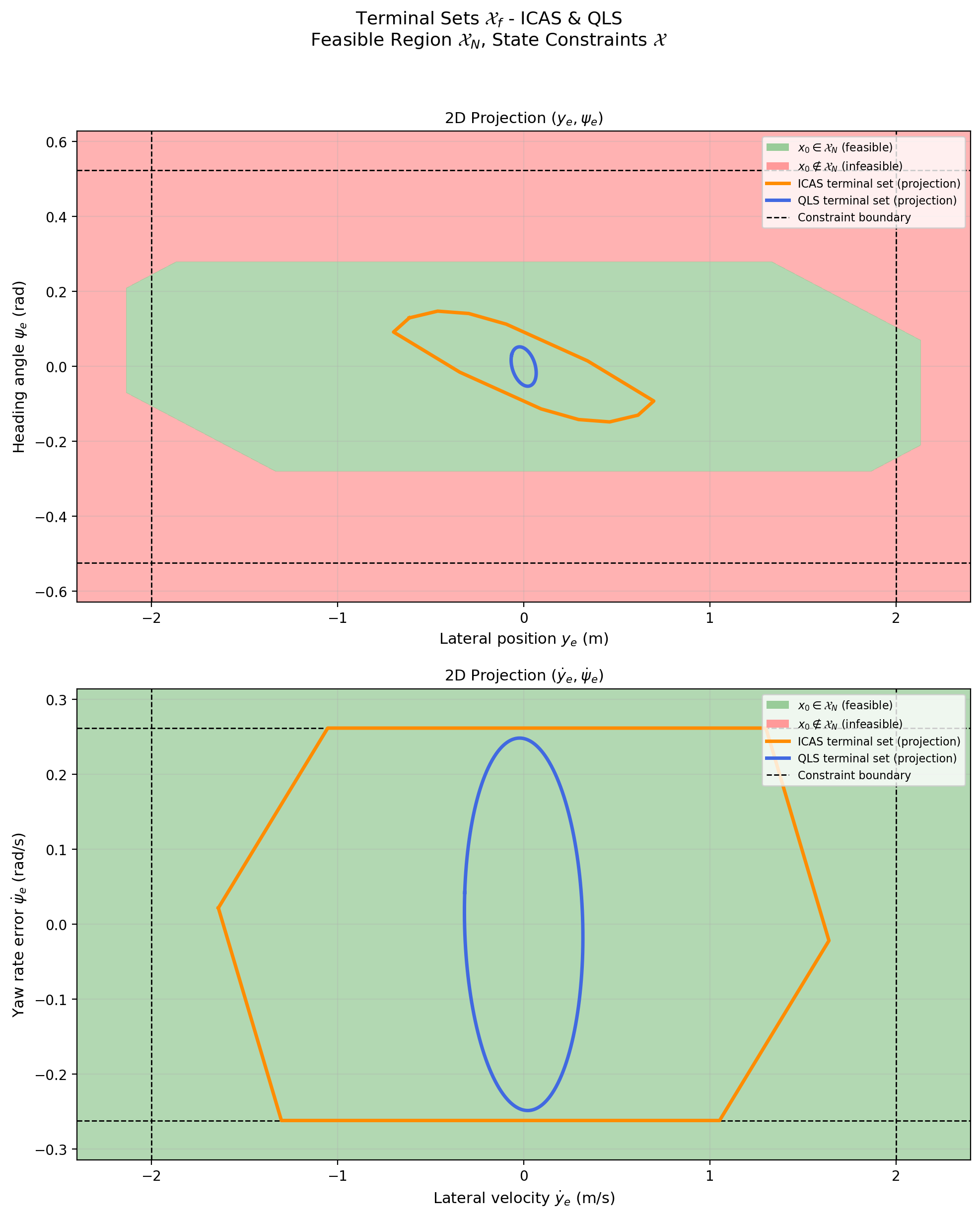
  • Terminal cost and invariant set from Riccati equation ensure stability
  • Offset-free MPC: augment state with disturbance observer for persistent curvature rejection
  • Optimal target selection adapts reference to estimated disturbance
  • Solved online at each sampling instant in receding-horizon form

Design Choices, Challenges & Insights

  • MPC enforces constraints explicitly — LQR violates them
  • Two terminal set designs compared: ellipsoidal (simpler) vs polytopic (less conservative)
  • Longer horizons increase computation without meaningful performance gain beyond feasibility
  • Observer gain trades off disturbance rejection speed vs noise sensitivity
  • Offset-free formulation enables non-zero reference tracking (e.g., obstacle avoidance)
  • Stability proven analytically and verified numerically via Lyapunov decrease
  • Linearized model is the main limitation — valid only near small angles and low slip
08

Robotic Manipulation & Control

Robot Dynamics and Control · TU Delft

Task: Subtask 1 uses a 4-joint redundant arm to track an endpoint trajectory while keeping an intermediate joint near the origin as a secondary task. Subtask 2 derives the full physics model of a 2-joint torque-controlled arm and controls it with an impedance controller along the same trajectory.

Solution: In subtask 1, two PID controllers run in parallel. The primary one tracks the endpoint using a damped pseudo-inverse Jacobian, while the secondary one targets the mid-chain joint and its velocity is projected into the null space so it never disturbs the endpoint. In subtask 2, the Lagrangian method produces the mass, Coriolis, and gravity terms. These drive a forward dynamics simulation each timestep. An impedance controller generates a spring-damper force from position and velocity error, converted to joint torques via the Jacobian transpose.

Pipeline

  • Compute endpoint and secondary endpoint via forward kinematics
  • PID errors feed two separate Cartesian velocity commands
  • Damped pseudo-inverse maps primary velocity to joint velocity
  • Null-space projector injects secondary velocity without affecting the endpoint
  • Subtask 2: impedance force mapped to joint torques via Jacobian transpose
  • Forward dynamics computes accelerations; Euler integration updates state

Design Choices, Challenges & Insights

  • Null-space projection mathematically guarantees the secondary task cannot disturb the primary endpoint
  • Secondary gains are set higher than primary to keep the elbow near the origin while remaining subordinate in priority
  • The damping term in the impedance controller is critical — without it the stiffness-only force causes persistent oscillations
  • Inertial coupling between joints is configuration-dependent and vanishes when the elbow is at a right angle
09

Simulation of an Electronic Differential for Electric Vehicles

Mechanical Engineering · NTUA
⚠ Thesis written in Greek

Modeling and simulation of an electronic differential for a lightweight electric vehicle with Ackermann steering geometry. Compares two in-wheel motor architectures — DC motor and PMSM — using FOC and SVPWM to evaluate vehicle stability, traction performance, and cornering behavior.

Experience

Internship — Task Scheduling Algorithm
Jul 2021 – Sep 2021
Enforge · Greece
  • Developed an experimental AI-oriented task scheduling algorithm to optimise production workflows
  • Integrated the algorithm into the Production Planning System to improve order and delivery time estimates
  • Analysed constraints: machine availability, setup times, inter-workstation transfer delays
  • Used Gantt charts and tree diagrams to present task dependencies; prepared data for an ML-based AI application
Research Engineer — Diploma Thesis
Jan 2022 – Dec 2022
NTUA · Greece

Thesis: Simulation of an Electronic Differential for Electric Vehicles

  • Proposed an Electronic Differential System (EDS) for a lightweight EV
  • Implemented the Ackermann-Jeantand model with two back-driving in-wheel setups
  • Compared DC motors (voltage control) vs. PMSM with FOC/SVPWM for efficiency and stability
  • Modelled and simulated the full control system in MATLAB/Simulink demonstrating vehicle stability on various terrains
Mobility Subsystem Engineer
Feb 2022 – Sep 2023
Beyond Robotics · Greece
  • Developed an autonomous mobile rover for the European Rover Challenge, designed for Mars-like conditions
  • Kinematics & dynamics analysis to optimise rover locomotion in Mars-like terrain
  • Designed and optimised the mobility and transmission system to improve navigation, traction, and terrain adaptability
  • Achieved best performance in the Science Task at ERC 2023
Construction Site & Project Manager
Sep 2023 – Sep 2025
Artemis ITS GmbH · Netherlands & Germany
  • Site Manager (Germany, Sep 2023 – Apr 2024): Led FTTH project team of 10; supervised fibre installation; coordinated permits with municipal authorities; managed logistics and equipment
  • Project Manager (Netherlands, Apr 2024 – Sep 2025): Stakeholder coordination; weekly production review and milestone tracking; risk & cost analyses; quality assurance across sites

Education

2025 – 2027
MSc in Robotics
Delft University of Technology · Delft, Netherlands
TU Delft 120 ECTS
  • 2-year MSc program
  • Specialising in autonomous systems, motion planning, intelligent control systems, robot dynamics and control, machine perception, and machine learning
  • Thesis: Not yet

Courses

Robot Dynamics and Control
Machine Learning for Robotics
Robot Software Practicals
Machine Perception
Planning and Decision Making
Human Robot Interaction
Robot and Society
Multidisciplinary Project
Knowledge Representation & Symbolic Reasoning
Intelligent Control Systems
Model Predictive Control
2017 – 2022
Integrated MEng in Mechanical Engineering
National Technical University of Athens · Athens, Greece
NTUA 300 ECTS
⭐ Grade: 8.84 / 10 — Top 5% of graduates
  • 5-year integrated programme
    • Bachelor equivalent 2017–2020
    • Master equivalent 2020–2022
  • Specialising in dynamics, control systems, fluid mechanics, thermodynamics, manufacturing, and mechanical design
  • Thesis on electronic differential simulation for electric vehicles

Courses by Semester

Semester 01
Mathematics A1 & A2
Mechanical Design I
Intro to Mechanical Engineering
Introduction to Computing
Mechanics A (Statics)
History of Science & Technology
Chemistry for Mechanical Engineers
Semester 02
Mathematics B
Physics
Mechanics B (Deformable Body)
Mechanical Design II
Engineering Materials I
Electric Circuits and Systems
Applied Thermodynamics Software
Semester 03
Engineering Materials II
Mathematics C
Operating Systems & Programming Languages
Mechanics C (Kinematics, Dynamics)
Machine Elements I
Electromechanical Power Conversion
Engineering Economics I
Semester 04
Mathematics D
Intro to Manufacturing Processes
Numerical Analysis
Mechanisms & Mechanical Design
Fluid Mechanics I
Machine Elements II
Heat Transfer I
Industrial Electronics
Semester 05
Statistics & Measurement in Engineering
Production Management & Business Administration
Metal Forming Processes
Hydraulic Turbomachines
Applied Fluid Mechanics
Machine Dynamics I
Thermal Energy Conversion
Semester 06
Material Removal Processes
Internal Combustion Engines I & Laboratory
Environmental Technology
Analysis of Mechanical Structures I
Intro to Automatic Control Systems
Thermal Turbomachines
Operational Research I
Semester 07
Aerodynamics
Applied Thermodynamics of Mixtures
Computational Fluid Dynamics
Dynamics of Internal Combustion Engines
Theory of Ground Vehicles
Advanced Control Systems
Semester 08
Practical Training
Introduction to Aircraft
Dynamic Straining
Principles of Jet Propulsion
Analysis of Mechanical Structures II
Basic Principles of Refrigeration
Design of Thermal Turbomachines
Semester 09
Intelligent Manufacturing Systems
Micro-Nanotechnology
Gas Turbine Diagnostics
Hybrid-Electric Vehicles
Lightweight Structures
Solar Energy
Semester 10 — Diploma Thesis
Theory of Ground Vehicles — Simulation of an Electronic Differential for Electric Vehicles (Grade: 10/10)

Contact

Open to collaborations, research opportunities, and robotics engineering roles. Feel free to reach out.

Delft, Netherlands